



Getting a card graded means sending it to a grading company. The company checks the card, gives it a grade from 1 to 10, and seals it in a hard plastic case called a slab. Knowing how to get cards graded is the easy part. The cost and the wait are where people get caught out.
On 22 October 2026, PSA's cheapest open service cost $59.99 a card. A graded 9 beat the raw price by $59.99 or more on only 22% of 15,870 Pokémon cards in our price data. Raw means ungraded: a loose card with no case. So the first step, choosing what to send, matters most.
How does PSA grading work?
PSA explains how cards are graded in three steps. First, its graders check that the card is real and has not been trimmed or recolored. Then they grade its condition: the corners, edges, surface and centering (how even the borders are). Last, PSA seals the card in a tamper-evident case, one that shows if anyone opens it, with a label.
The label shows the grade and a certification number. Anyone can look up that number on PSA's website or in its app. At PSA, at least two graders look at every card. To see what a card needs for a 10, read what PSA 10 means.
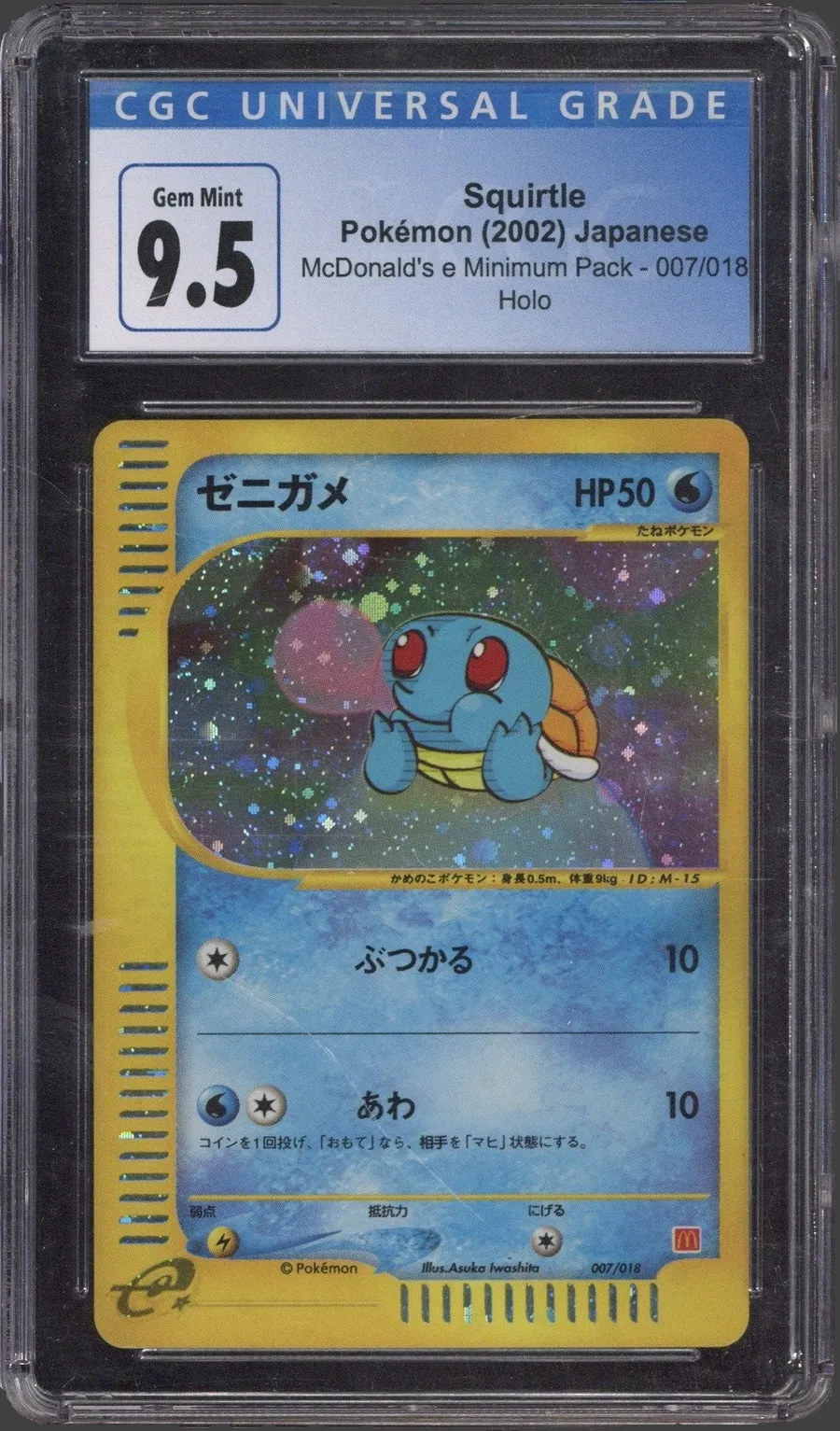
How to get cards graded, step by step
- Pick the cards worth grading.
- Choose a grading company.
- Fill in the online form.
- Pack the cards.
- Ship them, or drop them off.
- Wait, pay, and get your grades.

Step 1: Pick cards where a grade adds more than the fee
Grading costs money per card, so start with the sums. Find the raw price and the graded prices for the exact card, with its set and card number. Then ask: would the grade this card is likely to get add more than the fee?
If you plan to get Pokémon cards graded, here is how that sum looked for the ones we price, at PSA's $59.99 Standard fee.
| Raw price | Cards | A graded 9 adds $59.99 or more | A PSA 10 adds $59.99 or more |
|---|---|---|---|
| Under $5 | 7,213 | 2% | 36% |
| $5 to $20 | 4,140 | 15% | 68% |
| $20 to $100 | 3,084 | 50% | 91% |
| $100 and up | 1,433 | 76% | 99% |
| All cards | 15,870 | 22% | 61% |
Read the 9 column first. A 10 is never certain, so a 9 is the safer number to plan on. On cards under $5 raw, a 9 paid the fee on only about 2 in 100. Our PSA grading cost guide runs the full test for one card, with shipping and selling costs.
Then check each card yourself before you pay, for the same four things the graders check. Send the cards that look clean, not every card you own.
Step 2: Choose a grading company, such as PSA or CGC
The two names you will see most are PSA, short for Professional Sports Authenticator, and CGC, short for Certified Guaranty Company. In the 24 hours to 09:00 UTC on 22 October 2026, we counted the graded Pokémon cards pulled from packs on eight sites we track, where the site's feed names the grading company. Of those 81,564 cards, 75% were in PSA slabs and 24% in CGC slabs. Beckett Grading Services (BGS) and SGC together made up under 1%. On 40,473 graded sports cards in the same window, counted the same way, PSA's share was 97%.
That count shows which slabs these sites chose to stock. It does not rank the companies.
| Company and service | Fee per card | Card value up to | Estimated wait |
|---|---|---|---|
| PSA Standard | $59.99 | $1,000 | 90 to 100 business days |
| PSA Priority | $79.99 | $1,500 | 70 to 80 business days |
| PSA Express | $199 | $2,500 | 20 to 30 business days |
| CGC Bulk (25 cards or more) | $17 | $500 | 150 business days |
| CGC Economy | $20 | $1,000 | 90 business days |
| CGC Standard | $55 | $3,000 | 10 business days |
CGC is the cheaper way in, most of all with 25 cards or more. PSA is the label on most of the slabs we see. Pick by your budget and by the label your buyers look for.
Step 3: Fill in the online form and declare each card's value
Both companies take orders through an online form, and PSA also has an app. You do not need a paid membership. PSA takes orders from non-members, and CGC asks you to open a free account. CGC's paid memberships start at $39 a year and take 10% to 20% off its grading fees.
For each card, you enter its details and a declared value. PSA calls it the max insured value. It is your honest guess of what the card will be worth after grading, not what it is worth raw. That value sets your tier (the service level), your fee and your insurance cover. If PSA decides you set it too low, it can move the card to the right tier and charge you for it. CGC does the same.
That catches more cards than you might think. On 22 October 2026, we held a raw and a PSA 10 price for 16,110 Pokémon cards. As a PSA 10, 2,316 of them were worth more than $1,000, which is above the cap for PSA's Standard service.
Step 4: Pack each card in a sleeve and a semi-rigid holder
Packing has strict rules, and the wrong sleeve can delay your order. PSA's shipping guide asks for this:
- Put each card in a clear penny sleeve, a thin soft plastic sleeve. Do not use solid or opaque sleeves.
- Slide each sleeved card into a semi-rigid holder, a stiff plastic sleeve a little bigger than the card. Do not use toploaders (hard plastic holders), tape, pull tabs or sticky notes.
- Stack the cards in the same order as your form, with item 1 on top.
- Put the stack between two pieces of cardboard and hold it with 2 or 3 rubber bands. Make them tight enough to stop the cards moving, and no tighter.
- Wrap the stack, put it in a new box, fill the gaps, add the printed form, and tape every seam.
CGC asks for the same basics: a sleeve, a semi-rigid holder, cardboard on both sides, and a sturdy box with packing around the cards.

Step 5: Ship the cards, or drop them off in person
You pay to send the cards in and to get them back. At PSA, checkout gives you a FedEx label, and you are charged for it when FedEx scans the box. The return fee is one fixed charge per order, set by the card count and the declared value. PSA does not insure your box on the way in, so buy cover yourself if the cards are worth it.
You can also hand your cards in. PSA takes them in person at its submission events and at card shows. And in the US, some GameStop stores take cards for PSA grading. When we checked, GameStop charged $59.99 a card plus a flat $9.99 shipping fee per order, with no form and no card minimum. Your cards must be in penny sleeves and semi-rigid holders, which the store sells. You collect the slabs from the store when they are done. Once you pay, GameStop does not cancel or refund the order.
Step 6: Wait, pay, and get your grades
PSA's estimate for Standard was 90 to 100 business days on 22 October 2026, which is about four to five months. The clock starts when PSA scans your order in, not when the box arrives.
You can track the order online. PSA asks for payment when grading is done, and shows you the grades once you pay. Then you choose, card by card: ship it home, keep it in the PSA Vault, or sell it on eBay through PSA.
The fee pays for the grading, not for a good grade. If you do not agree with a grade, a review costs the full fee again. And PSA will not grade some cards, for example one it finds trimmed or cleaned. That card comes back without a slab, and you still pay the full fee.
Another way to get a graded card: open packs of slabs
If the wait puts you off, you can get a graded card without sending anything. Slab pack sites sell digital packs where every pull is a real graded card. On Courtyard and Collector Crypt, the card sits in a vault. You can sell it back to the site or have the slab shipped to you.
These are house-edge games for adults 18 and over, which means that on average, players get back less than they pay. We measure that gap in what pack openings actually pay back, and we compare the sites on our pack site rankings.

Questions people also ask
Which card grading company is the best?
No company is best for every card. PSA is the most common label on the sites we track, and CGC was second on Pokémon cards. CGC's Bulk tier cost $17 a card against $59.99 for PSA's cheapest open service.
How do you get cards graded in the UK?
CGC has a London office that takes card orders. Its Bulk tier cost £16.80 a card with VAT (UK sales tax) on 22 October 2026, with a 25-card minimum. PSA takes orders from outside the US too, but you pay international shipping and any duty or tax. Some dealers are licensed to take cards for PSA grading, and PSA lists them in its Dealer Directory.
How long does it take to get cards graded?
It depends on the service you pay for. On 22 October 2026, PSA estimated 90 to 100 business days for Standard and 20 to 30 for Express. CGC estimated 150 for Bulk and 10 for Standard. Neither company guarantees its estimates.