


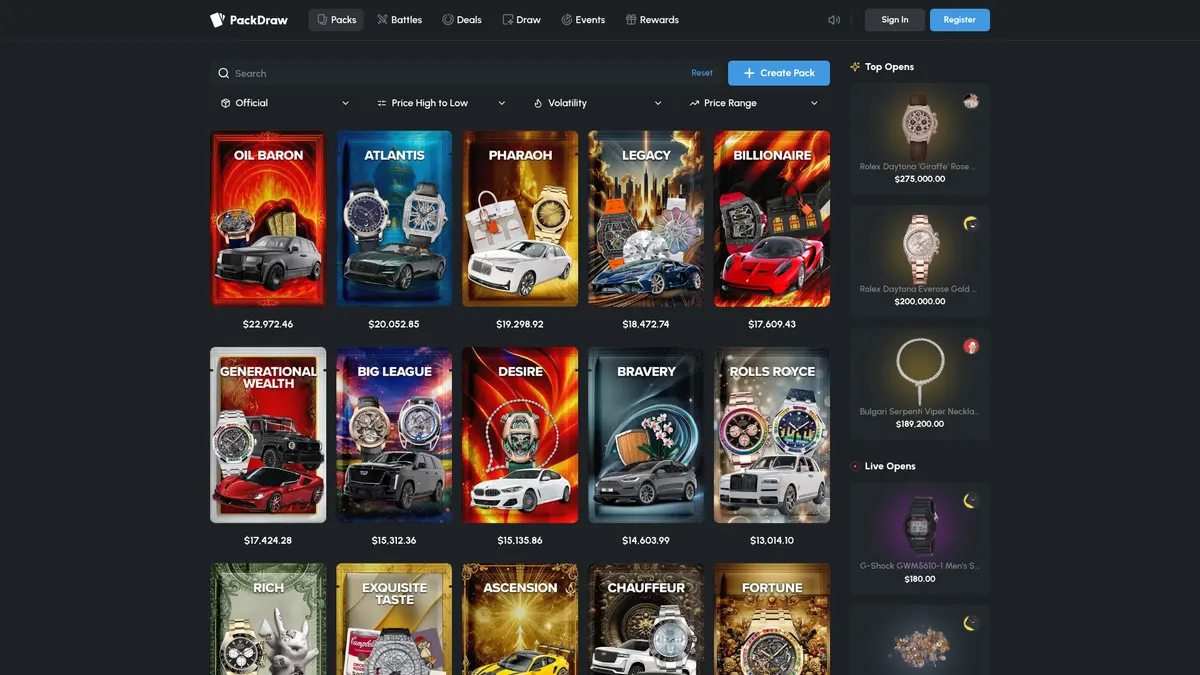
Is PackDraw gambling? In our reading of how it works, yes. You pay for a pack, luck picks what you get, and you can turn the prize into crypto. In law, nobody has decided. No US court has ruled that PackDraw, or any site like it, is gambling.
So we checked the part we can count: the odds. We read PackDraw's own odds on 557 of its Pokémon packs, and not one pays back what it costs. The middle pack returns 87 cents for every dollar.
We also record PackDraw's live feed. Since 27 September 2026 we log every Pokémon card pulled there worth $1 or more, plus every mystery box win of $100 or more. The feed hides every pull under $1, so we never print a payback figure from it. But it can test whether the printed odds hold up, and below we test it.
Is PackDraw gambling by the US definition?
Most US states call something gambling when three things happen together. You pay. Luck decides what you get. And you can win something of value. The US Supreme Court named the same three parts for a lottery in 1954: a prize, chance, and a price paid. Take one away, for example with a genuinely free way to play, and it is usually not gambling.
In our reading, PackDraw ticks all three on paper.
- You pay. Every pack has a price, and you buy it from a balance you fund.
- Luck decides. A spin picks one item from the pack's list.
- The prize has cash value. PackDraw's terms let you swap an item for its listed value and take that value out in crypto. Its homepage says it plainly: "Ship your prize or cash out instantly."
PackDraw's terms and fairness page do not use the word gambling. Its fairness page calls the site "gamified shopping", which means shopping turned into a game. Its terms name no gambling licence from anyone.

Has any court said PackDraw is gambling?
No. We checked on 22 October 2026. We found no court ruling and no state action that treats PackDraw, or any pack site, as gambling.
The sites' best defence is that you always get something. PackDraw's homepage promises: "You always walk away with a real, authenticated product." Courts have heard that idea before. In 2002 a federal appeals court agreed that a case against Fleer/Skybox and other card makers should be thrown out. Buyers had said chase cards, the rare cards everyone hopes to find, turned packs into gambling. The court said the buyers "received value" in the cards. So missing the chase card was not a loss the law could count. The court never decided whether packs were gambling.
The case to watch is in New York. On 25 February 2026 the state's Attorney General sued Valve, the company behind Counter-Strike, over its loot boxes. Those are paid random prizes inside a video game. The claim is that paying for a random item you can sell online for money is gambling. In May 2026 Valve asked the court to throw the case out. It argued that every player gets an item, and it compared loot boxes to baseball and Pokémon card packs. We found no ruling as of 22 October 2026. We make no judgment on its merit.
Our reading, which is not a ruling: the cash-out is what makes PackDraw look most like a bet. A site that only ships you the card is easier to call shopping. PackDraw's own terms also bar US residents from using the site or opening an account. Yet the site opens on a US version. Our state-by-state legal guide covers the court cases, the new state laws, and which states each site lets in.
How do PackDraw's odds work?
Every PackDraw pack prints its full list: each item, its value, and its chance. When you open one, PackDraw draws a ticket number from 1 to 1,000,000. Each item owns a range of those tickets, so an item with a 1% chance owns 10,000 of them.
Take a real pack. The Prismatic God Pack, at $4.96, had the most recorded pulls in our PackDraw feed from 15 to 21 October 2026. We read its odds on 17 October and again on 22 October, and they had not changed. It holds 35 items.
- An Eevee worth $1.73 has an 82.75% chance. That is 827,500 of the million tickets.
- The top card, an Umbreon VMAX worth $2,150, has a 0.005% chance. That is 50 tickets, or 1 pull in 20,000.
- The chance of any item worth $4.96 or more is 17.25%.
Now do the sum. Multiply each item's value by its chance and add them all up. For this pack the answer is $4.47. That is the average pull, and it is 90.2% of the price. So on average you lose about 49 cents every time you open it. That gap is the house edge, the cut the site keeps.
Do PackDraw's real pulls match its printed odds?
Printed odds only matter if the spins follow them. So we checked this pack against our own records. Every item in it is worth $1.73 or more, so none of its pulls fall under the $1 line our feed hides. On 21 October 2026 (UTC) we recorded 2,971 openings of it.
| Pull | Value | PackDraw's odds | What we recorded |
|---|---|---|---|
| Eevee | $1.73 | 82.75% | 84.0% |
| Eevee (Poke Ball Pattern) | $5.02 | 5.00% | 4.7% |
| Espeon ex | $5.96 | 4.00% | 3.9% |
| Anything worth the pack price or more | $4.96 or more | 17.25% | 16.0% |
That is close. The cheap Eevee came up about one point more often than printed. A gap that size can come from luck alone across one day of openings. One pack on one day is a spot check, not proof.
PackDraw also calls its spins provably fair. That means you can check that each result was locked in before you clicked. Our guide to what provably fair proves explains why an honest spin and a good deal are two different things.

Does any PackDraw pack pay back more than it costs?
Not by PackDraw's own odds. We did the same sum for 557 PackDraw Pokémon packs, reading each pack's page between 15 and 19 October 2026. Not one returns its price on average. The middle pack returns 87 cents per dollar. 547 of the 557 sit between 80 and 90 cents, and the best of all returns 93.9 cents.
Big pulls are rare too. In a typical pack, about 1 pull in 13 is worth the pack price or more. The other 12 are worth less than you paid. Our Pack Finder shows this sum for many PackDraw packs.
Keep two things in mind. First, these figures use PackDraw's own value for each item. An outside tester, BetterChecked, worked out the drop tables it opened at 87 to 91 percent. That is their sum, not ours, but it points the same way. Second, PackDraw's terms say an item is worth its listed value on the day you swap it. That is not the value it had on the day you won it.
What does our PackDraw feed show?
From 15 to 21 October 2026 we logged 116,773 Pokémon cards worth $1 or more from PackDraw. Most were small. On 21 October alone we logged 19,253, and three in four of them (74.5%) were worth under $2. The cheapest was exactly $1, because that is where the feed stops.
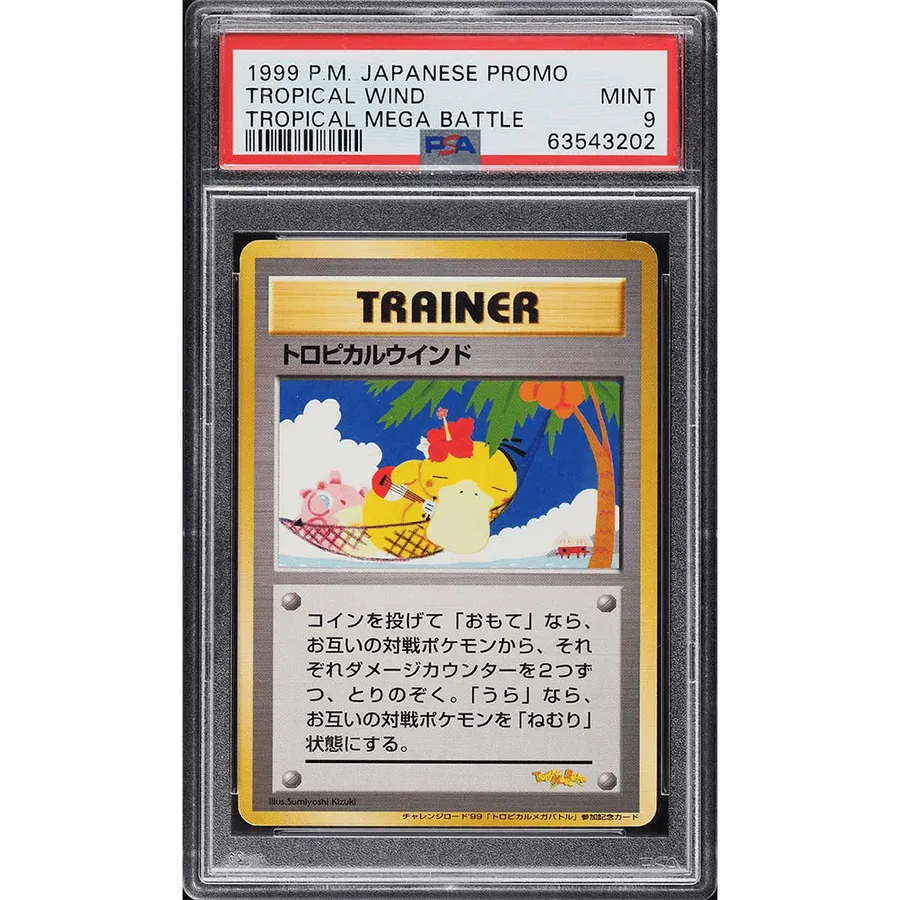
So a payback figure from this feed would count the hits and miss many of the losses. Big hits do land, though. Here is the biggest in our recent records.

If PackDraw feels like gambling, treat it like gambling
Whatever the courts end up saying, PackDraw is a paid game of chance with a house edge. It is for adults only. Its terms say you must be 18 or older, and also an adult under the law where you live.
- Read the odds sheet before you buy, and do the sum above.
- Set a budget and count it as spent the moment you deposit.
- Watch the swap and spin loop. Swapping a pull for balance feels like getting money back, but every new spin runs the house edge again.
- If you want money out, test a small withdrawal first. Withdrawals are the most common complaint in PackDraw's public reviews.
If you find yourself chasing losses, spending more to win back what you lost, talk to someone. In the US, the National Council on Problem Gambling's helpline is 1-800-MY-RESET (1-800-697-3738), by call or text.
Whether PackDraw is a good place to spend that budget is a different question. Our full PackDraw review answers it.
Questions people also ask
What is PackDraw gambling, exactly?
It is closest to a loot box with real prizes. You pay a fixed price, and a spin picks one item from a printed list. Then you ship the item or swap it for its value in crypto. No court has called it gambling, but in our reading that is how it works.
Is PackDraw a gambling site or a casino?
It is not a licensed one. Its terms name no gambling licence, and it calls itself "gamified shopping". But next to packs it runs battles against other players and a card-flip game called Draw. In Draw, each flip wins or loses on a ticket number. Those feel more like casino games than a pack does.
Is PackDraw rigged?
Our spot check says the spins follow the printed odds closely. On 21 October 2026, 84.0% of 2,971 openings of one pack gave its cheapest card, against 82.75% printed. The real cost is in the odds themselves: by PackDraw's own numbers, every pack we read returns less than its price.
Is PackDraw still gambling if you only ship the cards?
Our reading is that shipping does not remove any of the three parts. You still pay, luck still decides, and a real card can be sold on. The cash-out only makes that value quicker to reach. No court has ruled on this either way.