



Are mystery boxes gambling? Our reading: in how they work, yes. In law, nobody has decided. No US court has ruled that a mystery box site is gambling.
So we checked the part we can count: the odds. We summed the printed odds of 3,749 boxes on six mystery box sites on 21 October 2026, and none pays back its price on average. In the typical box, about 84 opens in 100 give a prize worth less than the box cost.
Are mystery boxes gambling under US law?
Most US states call something gambling when three things happen together. You pay. Luck decides what you get. And you can win something of value. The US Supreme Court named the same three parts for a lottery in 1954: a prize, chance, and a price paid. Take one away, for example with a genuinely free way to play, and it is usually not gambling.
Our reading, which is not a ruling: a mystery box site ticks all three on paper. You buy the box. A spin picks one item from a printed list. And the item is a real thing with a price, like a pair of sneakers, a watch or a graded card.
How do mystery box sites say they are not gambling?
The sites give three answers.
- "You always get something." Lawrence Walters is a gaming lawyer at Walters Law Group. In December 2025 he wrote that a box raises no gambling concern "so long as the user always receives" items worth what they paid. He also called this a "relatively untested legal theory".
- "It is shopping." LuxDrop calls itself gamified e-commerce, meaning shopping made into a game, and not gambling. HapaBox calls itself an online retailer. HypeDrop's FAQ says it holds no licence because it does not consider itself gambling.
- "It is a sweepstakes." Cases.gg sells Gold Coins, which have no cash value, and adds Cases Cash as a bonus. Only Cases Cash can win a real prize, and its rules offer a free entry by post. Krush.gg publishes sweepstakes rules too.
Our numbers can test the first answer. A box that pays back less than its price on average must hold prizes worth less than its price. So by the sites' own odds, none of the 3,749 boxes we read passes that test. Our reading, which is not a ruling: "you always get something" is true, but you usually get something worth less than you paid.

Do mystery boxes pay back what they cost?
Not on average, by the sites' own odds. Every box we track prints them: each prize, its value and its chance. Multiply each value by its chance, add them up, and divide by the box price. That tells you how much of each dollar comes back on average. The rest is the house edge, the cut the site keeps.
We read those odds from each site every day. Here is what we read on 21 October 2026.
| Site | Boxes read | Typical box pays back | Opens worth less than the box price, typical box |
|---|---|---|---|
| HypeDrop | 867 | 90.1% | 80% |
| LuxDrop | 501 | 90.0% | 82% |
| Cases.gg | 428 | 89.5% | 86% |
| Upgrader.com | 422 | 89.3% | 82% |
| Jemlit | 344 | 80.0% | 85% |
| Boxed.gg | 1,187 | 80.0% | 87% |
Typical means the middle box, when all of a site's boxes are lined up from lowest to highest. The Boxed.gg row covers 1,187 of its boxes. Our Boxed review checked five of its boxes and found about 85%.
Three sites sit outside the table on purpose. Krush.gg prints its own margin, the share it keeps, on every box. On 21 October its 145 boxes kept 10% to 15%. HapaBox sets its own sticker prices, and at those prices some boxes look like they pay back more than they cost. At the lower price HapaBox pays you when you sell a prize back, the middle box returns 72%, by our review's sum. RillaBox prints a chance beside every prize but states no house edge. Our mystery box page shows one rough figure for it, about 87.6% paid back on 22 October 2026, but that rests on only 594 drops from its live strip.
Do real opens match the printed odds?
On Cases.gg, they come close. Printed odds are a promise, and Cases.gg lets us check it closely. Its live feed shows every bet, losses included, and it prints its house edge in its own FAQ.
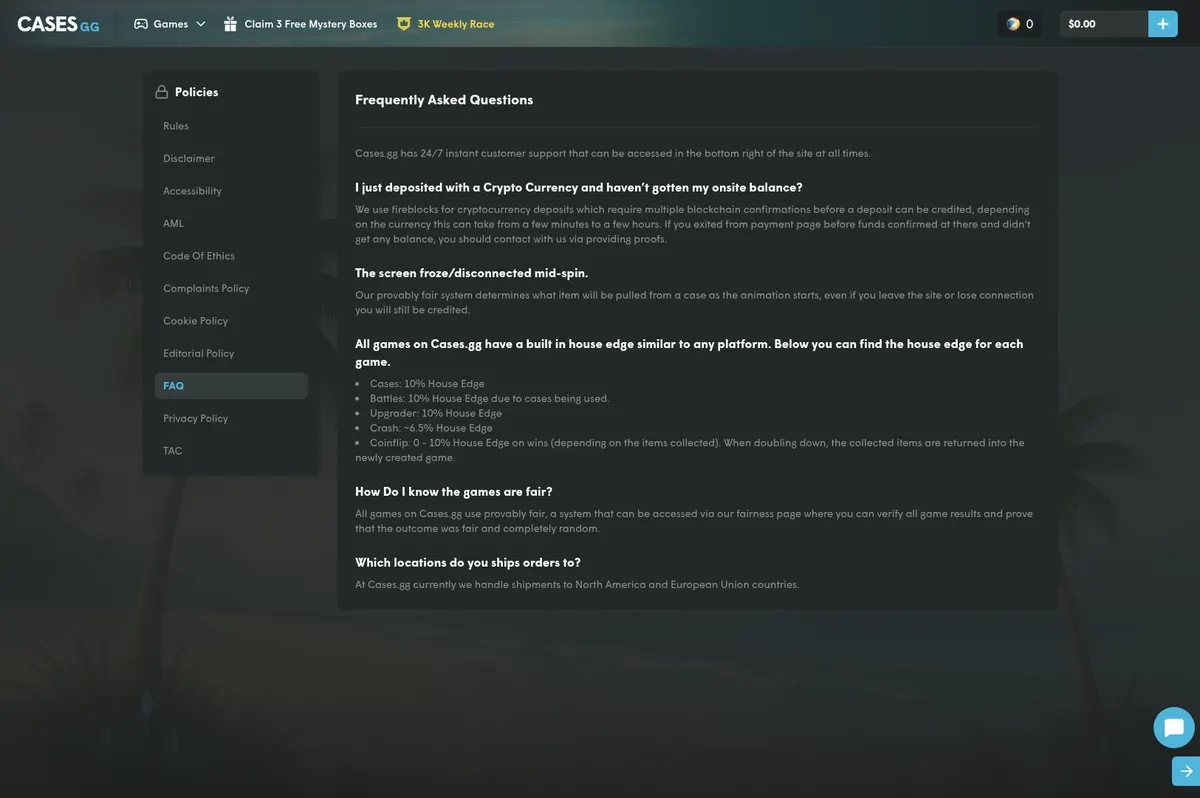
In the 30 days to 21 October 2026 we recorded 118,790 Cases.gg box opens. They paid back 90.8% of what was spent, close to the 10% edge the site prints. And 86.5% of those opens gave a prize worth less than the box cost. That is close to the 86% its printed odds give for its typical box.

Do mystery box sites run casino games too?
Several do, on the same balance you use to open boxes. Our reviews found crash and coinflip on Cases.gg, crash and Plinko on RillaBox, and mines and blackjack on LuxDrop. Upgrader.com goes furthest. On 22 October 2026, its homepage put boxes next to six other games.
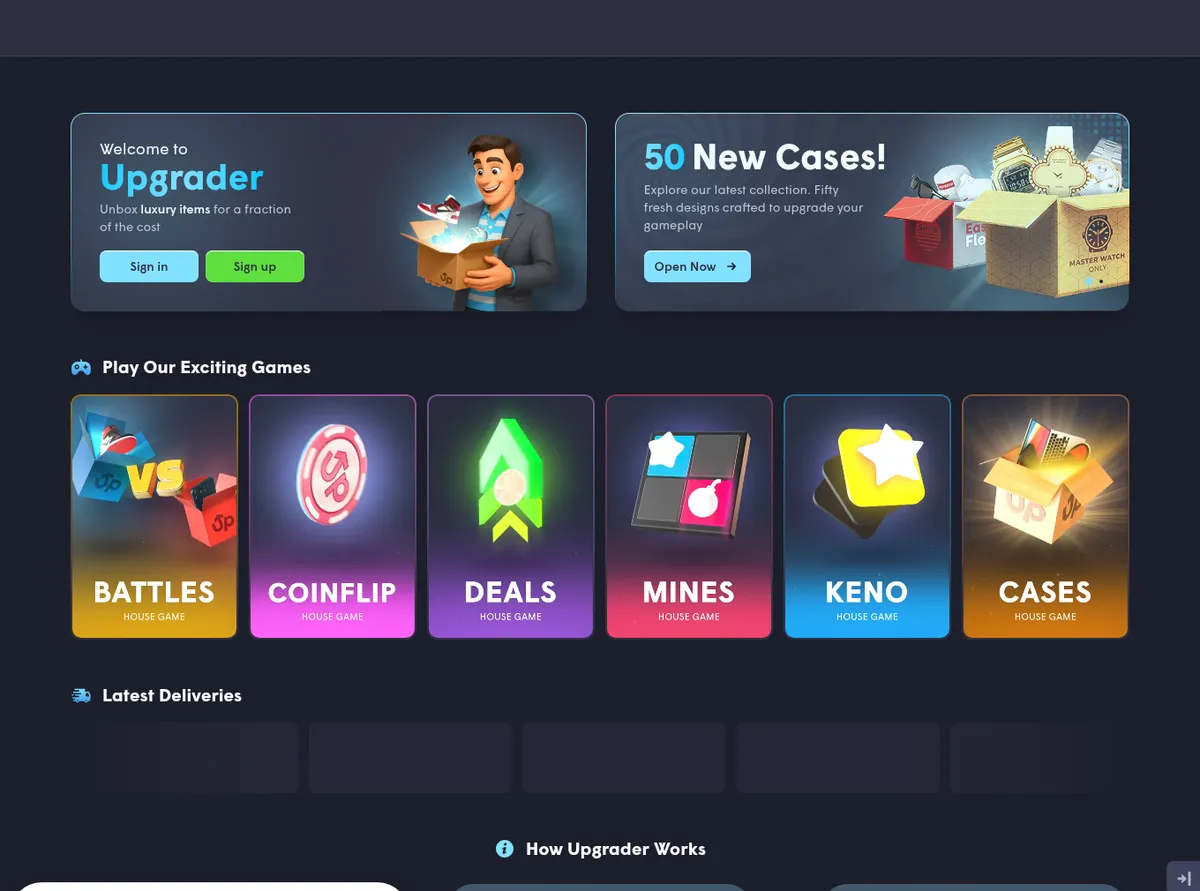
We record Upgrader's live feed too. In the 30 days to 21 October 2026 we logged 177,100 keno bets and 175,227 mines bets there, against 18,671 box opens. However a court rules on boxes, keno and mines are casino games.
Can you cash out a mystery box prize?
On most sites, yes. All nine sites below let you ship the item. Seven of the nine box sites whose odds we read also let you take its value out in crypto. For the mystery box gambling question, this is the part that matters most: the third test, a prize of value.
| Site | Can you take a prize's value out? |
|---|---|
| HypeDrop | Yes, in crypto, from $15, with a 2% fee |
| Cases.gg | Yes, in crypto, after an ID check. Gold Coins never cash out |
| RillaBox | Yes, in crypto, from $25 |
| HapaBox | Yes, in crypto, from $100 |
| Upgrader.com | Yes, in crypto, or ship the goods |
| LuxDrop | In crypto, with a fee, but its terms say it "may allow" this "from time to time" |
| Krush.gg | Yes, to a balance you can withdraw, once bonus money is played through |
| Boxed.gg | Yes, in crypto after an ID check and approval, or as a shipped card or a CS2 skin sent to Steam |
| Jemlit | No. Ship the item or sell it back for credits |
Are loot boxes gambling?
A loot box is a paid random prize inside a video game. US courts have thrown out several loot box cases, and the reason matters here. In January 2022 a federal court in California dismissed one against Google. Following earlier rulings, it said loot box prizes "are not things of value under California gambling laws".
The UK government made the same point in July 2022, when it chose to keep loot boxes outside its gambling law. It called the ability to cash out rewards "an important distinction".
The case to watch is in New York. On 25 February 2026 the state's Attorney General, its top lawyer, sued Valve, the company behind Counter-Strike, over its loot boxes. The claim is that paying for a random item you can sell online for money is gambling. In May 2026 Valve asked the court to throw the case out. It argued that the same logic would catch Pokémon card packs and blind boxes, sealed toys you buy without knowing which one is inside. We found no ruling as of 22 October 2026. We make no judgment on its merit.
Our reading, which is not a ruling: a mystery box prize is a real item. You can ship it, sell it back, and on most sites turn it into crypto. That is what the loot box rulings said was missing. We test one site in detail in Is PackDraw gambling?
Which states do mystery box sites block?
Washington, most of all. The sites' own rules show where they feel exposed. On 11 October 2026 we read the rules of the 10 mystery box sites we review.
- Washington: Boxed.gg, Cases.gg, Krush.gg and Upgrader.com block it, and HypeDrop and HapaBox close parts of their sites there. Washington treats online gambling as a felony, a serious crime.
- Krush.gg blocks 21 states in its terms, New York and New Jersey among them.
- Cases.gg takes US players only, minus Idaho, Michigan, Montana, Nevada and Washington.
- Boxed.gg's help centre says it is not available in Louisiana, Michigan, South Carolina or Washington. We read it on 22 October 2026.
- RillaBox names no state that it blocks.
All of this comes from the sites' own rules about who can sign up. It is not legal advice. Our state-by-state legal guide lists every site for every state, plus the new sweepstakes laws that could reach box sites.

If it feels like gambling, treat it like gambling
Whatever the courts decide, a mystery box is a paid game of chance with a house edge. Every box site we review sets the minimum age at 18.
- Read the two or three most common prizes in a box, not the top one. Those are what you will mostly get.
- Set a budget and count it as spent the moment you deposit.
- Leave the casino tabs alone. They run on the same balance.
- If you want money out, read the cash-out rules before you deposit, not after you win.
If you find yourself chasing losses, spending more to win back what you lost, talk to someone. In the US, the National Council on Problem Gambling's helpline is 1-800-MY-RESET (1-800-697-3738), by call or text.
If you still want to open boxes, compare the sites first. Our mystery box rankings line them up by their odds and our live feeds.
Questions people also ask
Are loot boxes illegal?
No US law bans them. Belgium is the clearest case abroad. In 2018 its Gaming Commission found the loot boxes in FIFA 18, Overwatch and CS:GO were games of chance under Belgian gaming law. It warned of up to five years in prison and fines up to €800,000. The Netherlands tried too, but its top administrative court overturned the regulator in 2022. Back in the US, the maker of Genshin Impact agreed in 2025 to pay $20 million to settle charges from the FTC, the US trade regulator, partly over allegedly misleading loot box odds.
Is Boxed.gg gambling?
It works like any mystery box: you pay a fixed price, and the printed odds pick your card. Boxed says its Gems have no cash value. Value leaves as a shipped card, a CS2 skin sent to Steam, or crypto after an ID check and approval. No court has ruled on it. Our Boxed.gg review has the full picture.
Are mystery box sites gambling in the UK?
We found no UK ruling on mystery box sites. The UK kept loot boxes outside its gambling law in 2022, partly because their prizes cannot normally be cashed out. Some box sites keep away anyway. HypeDrop's terms now block the UK entirely, and HapaBox gives UK residents limited access.
Is opening sealed card packs gambling too?
No US court has said so. In 2002 a federal appeals court threw out a case over chase cards, the rare cards in sealed packs. It said buyers "received value" in the cards they got. It never decided the gambling question. Valve now uses card packs as part of its defence in the New York case.